
Top Emergency HVAC Services in Cherokee, NC, 28719 | Compare & Call

Qualla Heating And Air is your trusted, local HVAC specialist serving Cherokee, NC, and the surrounding Smoky Mountain region. We understand the unique demands of our climate and the common issues tha...
Q&A
Can I upgrade my air filter to help with spring pollen and general haze?
Yes, addressing April pollen peaks and particulate matter (PM2.5) risk is wise for indoor air quality. A MERV-13 filter is highly effective at capturing these allergens and fine particles. However, your home's flexible R-6 insulated ducting may have higher inherent static pressure. Installing a MERV-13 filter without verifying the system's airflow capacity can strain the blower motor. A technician should perform a static pressure test to ensure your specific ductwork can handle the higher filtration without reducing efficiency or causing freeze-ups.
What if my heat pump stops cooling on a hot afternoon in Big Cove?
A sudden loss of cooling requires a systematic check: ensure the thermostat is set correctly and the circuit breaker is on. If those are fine, a professional diagnosis is needed. Our service team, dispatched from near the Oconaluftee Visitor Center, uses US-441 to reach most Big Cove homes in about 12 minutes. This quick response is crucial to prevent indoor humidity from spiking and to address common issues like a tripped safety switch or refrigerant leak before they cause further damage.
My Cherokee home's original HVAC unit is still running. Should I be concerned?
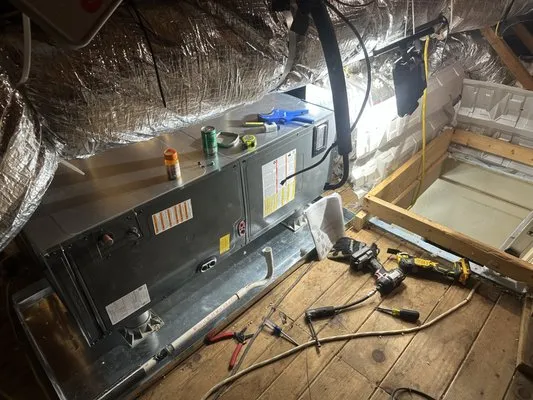
A system from a home built around 1985 is now about 40 years old, which is well beyond its expected service life. In the humid environment of Cherokee, NC, the flexible R-6 insulated ducting and older evaporator coils create ideal conditions for condensate drain line algae buildup, a primary failure point. This biological growth can lead to water damage and system shutdowns. Proactive maintenance can delay the inevitable, but component failure and declining efficiency become highly probable at this age.
My Ecobee thermostat is showing an 'E1' alert. What should I do?
An Ecobee E1 error code indicates the thermostat has lost communication with your HVAC equipment. First, check that the system's power switch and circuit breaker are on. If power is confirmed, the issue is often a failed control board, a blown low-voltage fuse on the indoor unit, or a wiring problem. In Cherokee's humid climate, corrosion on terminal connections can also interrupt this signal. This alert prevents the system from operating, so it requires a service call to diagnose and restore the 24-volt control circuit.
Are there new safety rules for the refrigerant in a 2026 system installation?
Yes. The industry-wide transition to mildly flammable A2L refrigerants like R-454B and R-32 mandates updated safety standards. As of 2026, all installations must follow strict codes for leak detection, ventilation, and signage. In Cherokee, permits for this work are issued by the Eastern Band of Cherokee Indians Building Inspections office. Only EPA-certified technicians with specific training on A2L safety protocols should handle these refrigerants. Proper documentation and system labeling are now legal requirements, not just best practices, for any new installation or major repair.
What does the new 14.3 SEER2 minimum efficiency standard mean for my utility bills?
As of 2026, all new central air conditioners and heat pumps must meet a 14.3 SEER2 rating, a measure of seasonal energy efficiency. For Cherokee homes with an average local rate of $0.14/kWh, upgrading from a pre-2023 10 SEER unit to a new 16 SEER2 model can reduce cooling costs by roughly 30%. The active federal Inflation Reduction Act rebates, with an $8,000 cap, directly offset this higher upfront cost, making the payback period for a high-efficiency system significantly shorter.
Why does my AC struggle when it gets above 95°F in the summer?
Residential HVAC systems in Cherokee are typically sized for a 86°F design temperature, balancing efficiency and cost. When ambient temperatures climb into the mid-90s, the system's capacity to reject heat diminishes, and it may run continuously to maintain setpoint. The newer R-454B refrigerant standard performs better in these high-temperature conditions than older R-410A, offering slightly improved capacity and efficiency. Proper sizing, clean coils, and adequate airflow are critical for optimal performance during these peak heat events.
I use propane heat. Is switching to a heat pump a good idea for Cherokee winters?
A modern cold-climate heat pump is a viable primary heat source for most Cherokee winters, especially given Duke Energy's peak hours from 14:00 to 18:00 when electric rates are highest. These systems efficiently extract heat from outdoor air down to near 0°F. The economics depend on your propane cost versus the $0.14/kWh electricity rate. The significant federal rebates for heat pumps make the switch more attractive. A hybrid system, which uses a heat pump as the primary heater and your propane furnace as a backup for the coldest hours, often provides the optimal balance of comfort and operating cost.
