
Top Emergency HVAC Services in Sayville, NY, 11716 | Compare & Call


Temp Tee Heating And Air Conditioning has been a reliable resource for comfort and efficiency in Sayville, NY, and across Suffolk County for years. As a local, family-run business, we understand the s...
Charge It Plumbing & Heating
Charge It Plumbing & Heating is a family-owned and operated plumbing and HVAC company serving Sayville, NY, and all of Suffolk County for over 35 years. We offer a comprehensive range of services, inc...
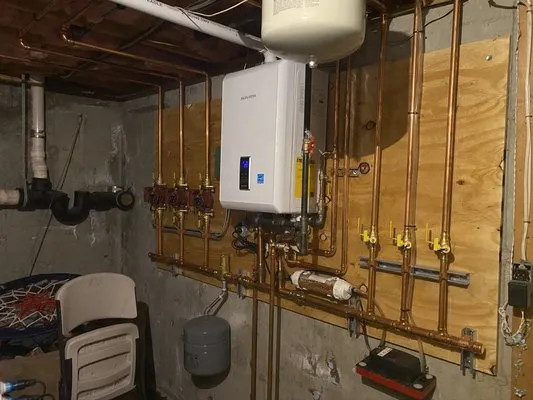
Rc Plumbing
RC Plumbing is a certified Navien plumbing and HVAC service provider serving Sayville, NY, and surrounding areas. We specialize in high-efficiency Navien units and offer a comprehensive range of servi...
Bob Mulry Plumbing & Heating
Bob Mulry Plumbing & Heating is a trusted, full-service provider for Sayville, NY, residents. We specialize in plumbing, water heater installation/repair, and heating & air conditioning services to ke...
Gross Alan S Plumbing & Heating
Gross Alan S Plumbing & Heating is a trusted, local service provider in Sayville, NY, specializing in comprehensive plumbing and HVAC solutions. The team understands the common local challenges homeow...
Cgm HVAC Mechanical is your trusted, locally owned and operated heating and cooling partner in Sayville, NY. We are dedicated to providing honest, reliable service for all your HVAC needs. Specializin...
Priced Rite Fuel is your local, trusted partner for heating and HVAC solutions in Sayville, NY. We understand the specific challenges homeowners face, such as short cycling furnaces and uneven heating...
Frequently Asked Questions
I use gas heat. Should I consider a heat pump for my Sayville home?
A modern cold-climate heat pump is a viable primary heating system for this region. While winter lows can challenge any system, units using R-454B refrigerant provide efficient heat output down to near 0°F. The economic case is strengthened by shifting load away from gas to electricity, especially if you can avoid the utility peak hours of 2 PM to 7 PM. The substantial HEEHRA rebate applies to qualified heat pumps, making the switch from a gas furnace to a high-efficiency dual-fuel or all-electric system more financially accessible.
Is now a good time to replace an inefficient air conditioner for financial reasons?
March 2026 is an optimal time due to updated federal standards and incentives. All new systems must meet a minimum 14.3 SEER2 rating, a significant efficiency jump from older units. With PSEG Long Island electricity rates at $0.24 per kWh, a high-SEER2 unit reduces operating costs. The active HEEHRA rebate provides a point-of-sale discount of up to $8,000, which, combined with a potential $1,000 utility rebate, dramatically lowers the net investment in a modern, efficient system.
My Ecobee thermostat is showing an 'E1' alert. What does that mean?
An Ecobee E1 error code indicates the thermostat is not detecting a signal from your HVAC equipment. In Sayville, this often points to a control board failure, a blown low-voltage fuse on the furnace, or a wiring issue exacerbated by system age and humidity. It is a diagnostic starting point, not a final diagnosis. A technician will trace the 24-volt control circuit from the thermostat to the air handler to locate the open circuit or failed component, which is a common repair for systems of the average local age.
What are the legal and safety requirements for a new AC installation?
All installations require a permit from the Town of Islip Building Division. As of 2026, systems using A2L refrigerants like R-454B, which are mildly flammable, must adhere to updated safety codes. These include specific clearance requirements, mandatory leak detectors in certain applications, and specialized technician certification (EPA 608 Type II or III). Proper permitting ensures the installation meets these updated standards for safe handling and operation, protecting your home and validating manufacturer warranties.
Can my home's ductwork handle better air filters for pollen and ozone?
Upgrading filtration addresses Sayville's May pollen peak and summer ozone risk. Your existing galvanized sheet metal ductwork is typically robust enough to handle a higher-efficiency MERV-13 filter, which captures fine particulates. However, installing such a filter in an older system without checking static pressure can restrict airflow, reducing cooling capacity and straining the blower motor. A technician should measure external static pressure to ensure your specific furnace and duct system can accommodate the upgrade without negative effects.
How well will a new air conditioner handle our hottest summer days?
HVAC systems are engineered to a specific design temperature, which for this area is 88°F. On days that exceed this temperature, which occurs during summer heatwaves, the system must run continuously to maintain temperature and may fall slightly behind. The new standard R-454B refrigerant maintains stable pressure and cooling capacity better than older refrigerants under these high-load conditions. Proper sizing via a Manual J load calculation is critical to ensure the system has adequate capacity without being oversized.
What if my air conditioning stops working on a hot day in Sayville Downtown?
A no-cool emergency requires a fast, local response. A technician based near the Sayville Fire Department can access Sunrise Highway (NY-27) to reach most homes in the downtown area within 15-20 minutes. The initial dispatch focuses on restoring cooling, often by addressing a tripped circuit breaker, a faulty capacitor, or a refrigerant leak—common immediate issues that can be diagnosed and often temporarily resolved on the first visit.
My HVAC system seems old. How long do they typically last here?
The average home in Sayville was built in 1965, meaning many original or replacement systems are approaching 30-40 years old. A unit of this age is well beyond its expected service life of 15-20 years. This advanced age, combined with the salt-air environment from the Great South Bay, significantly accelerates condenser coil corrosion. This is the most common failure point, as the aluminum fins deteriorate, reducing efficiency and leading to refrigerant leaks.
